I sat at my kitchen table, staring at my phone screen. My finger hovered over the confirm button in my banking app. Another payment for my father’s private nursing home was sent—a mechanical action that no longer brought tears, only a dry bitterness in my throat. My “autopilot” was functioning perfectly.
My husband, Mark, walked into the kitchen humming a tune. He set a coffee mug down on the table. Too loudly. The ceramic clinked against the wood. I flinched. My shoulders shot up to my ears; my jaw clenched. I waited. I waited for a shout, a reprimand, a blow.
“Oh, sorry, honey,” Mark said gently, noticing my reaction. “I’m just a bit sleep-deprived.”
He walked over and placed a hand on my shoulder. I didn’t pull away, but the trembling inside wouldn’t stop. Forty-five years old. Thousands of hours of therapy. And yet—I still have a Pavlovian response to the sound of clattering dishes or a raised voice.
“Look at what’s going viral,” he said, handing me his phone to change the subject. “This cat is all over the feed today. His name is Precious.”
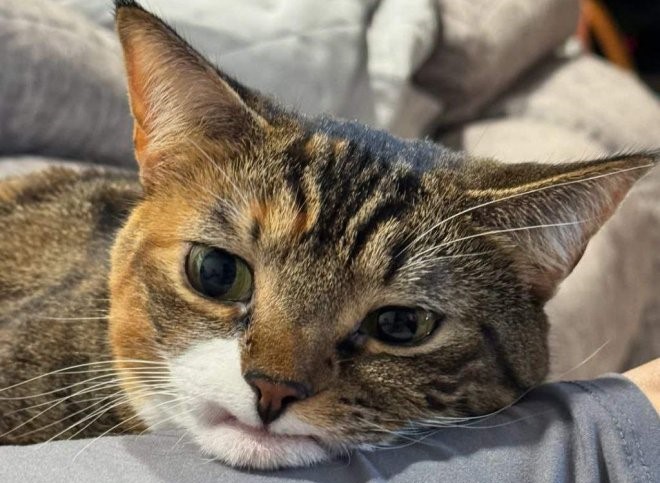
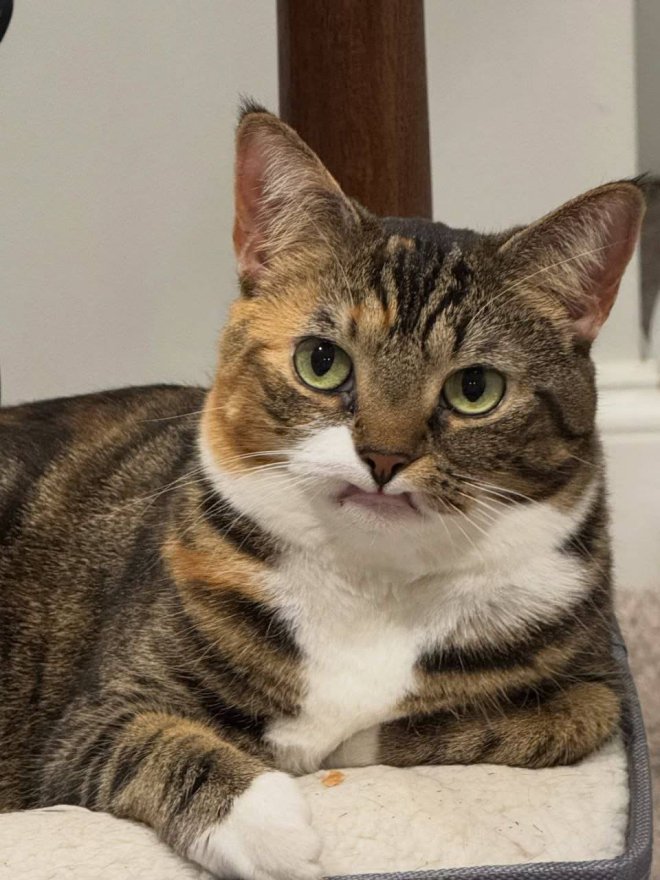
I looked at the screen. A fluffy gray face stared back at me. He had a strange, almost comical expression. Because he was born without his two upper canine teeth, his upper lip tucked inward slightly, creating a look of profound, existential grumpiness. He looked like he had just read the morning news and decided he wanted no part of humanity anymore.
“Precious?” I asked. “He looks like he’s about to curse the entire world.”
“That’s the thing. He has a defect, and people are obsessed. Five million views in twenty-four hours.”
I stared at the cat and felt a sudden pang in my chest. Not pain, but… recognition.
The Cult of “Normalcy”
In my father’s house, there was no room for defects. Everything had to be “perfect.” Grades had to be straight A’s. The garden had to be free of a single weed. Behavior had to be robotic. Any deviation from the norm was a personal insult to my father. If I missed a physics formula, it wasn’t a child’s mistake—it was a “sign of a rotten character.”
My father often said, “You must be normal. Functioning. So I don’t have to be ashamed of you.”
But this cat… he was “broken.” He was missing teeth. His face was “wrong.” By the logic of my childhood, such a cat had no right to exist, let alone be loved. He should have been “punished” for failing to meet the standard of feline beauty.
Yet the world had gone mad for him. They called him the “grumpiest little cloud.” People wrote: “Precious is me every Monday,” and “He is perfect in his imperfection.”
I started following the blog. At first, it was curiosity; then, it became a desperate hunger.
The owner, a young woman, posted videos of Precious trying to catch a fly, missing, and tumbling off the couch. She didn’t scream at him. She didn’t call him stupid or worthless. She laughed, kissed his pink nose, and said, “Oh, my clumsy hero.”
For me, it was a revelation. It turns out you can make mistakes—and still be loved. You can have a “defect”—and be celebrated. You can be grumpy—and not be beaten for it.
The Viral Healing Effect
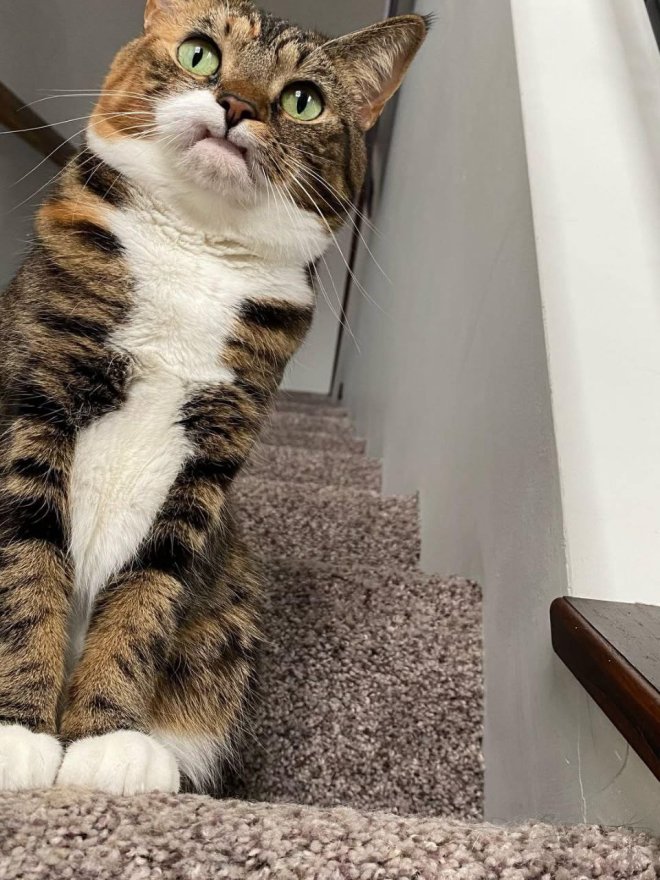
A week later, Precious was a full-blown meme. His face was on t-shirts. But it was a specific video that broke me. The owner was talking about his health: “He has no canines, so he struggles with hard kibble. We just soak it or give him pâté. It’s not a problem; it’s just a trait.”
It’s not a problem. It’s just a trait.
Those words looped in my head the next time I drove to the nursing home. My father sat in a wheelchair, staring out the window. The right side of his face was frozen from the stroke. The terrifying man who once seemed like a giant capable of destroying the world with a scowl was now a fragile old man in a diaper.
I approached him. He tried to say something, but only an incoherent mumble escaped. His lip twitched involuntarily.
In that moment, I didn’t see a tyrant. I saw… Precious.
It sounds sacrilegious, I know. Но I saw a being with a defect. A being who could no longer meet his own cult of strength and perfection. His life now depended on the very “ungrateful” people he had spent his life trying to break.
“Dad,” I said quietly. “You always wanted me to be normal. Но normal people don’t exist. There are only wounded people and people pretending they’re okay.”
He looked at me. In his one working eye, something like realization flickered. Or maybe it was just a shadow from the trees outside.
“I’m not afraid of you anymore,” I continued. “Not because you’re weak. But because I’ve allowed myself to be ‘wrong.’ I’ve allowed myself not to care for you personally, not to throw my life on the altar of your redemption. I’ve allowed myself to be the ‘bad daughter’ in your eyes, because that’s the only way I can stay a good mother to my children.”
I walked out of the room. Мой phone chimed. A notification from Instagram: “New video from Precious.”
In the video, the cat sat on a windowsill watching the rain. The caption read: “Precious is sad today because the birds flew away. And it’s okay to be sad, even when millions love you.”
Lessons from a Toothless Cat
Why does a story about a cat go viral? Why do we cling to these imperfect animals?
Because we are all Precious.
Every one of us is missing “teeth.” For some, it’s a physical ailment. For others, it’s a hole in the soul the size of a father’s belt. For some, it’s a fear of loud noises that won’t fade after decades.
We live in a world that demands “pearly white smiles,” productivity, and perfect family portraits. We post vacation photos to hide the dark circles under our eyes from insomnia or the bruises on our hearts from old grudges.
And then comes Precious. A grumpy, toothless, ridiculous cat. And he tells us simply by existing: “Hey, I’m not thrilled with this world, and I don’t look like a magazine cover. But I’m here. And I’m getting the pâté. And I’m a star.”
That gives us hope.
My Personal “Pâté”
Today is Saturday. The very day of the week I feared until I was twenty-four. Saturday—the day of “preventative spanking,” the day you had to be quieter than a shadow.
I am at home. My children, my son and daughter, are building a pillow fort in the living room. They are loud. They are screaming. They accidentally knock over a vase of flowers. Water spills across the hardwood floor.
In the past, I would have gasped. I would have started scrubbing the floor frantically, bracing for the thunder.
Instead, I look at the spilled water. I look at my children. “Mom, we didn’t mean to!” my son shouts, freezing as he waits for my reaction.
I take a deep breath. I remember the face of Precious the cat. His grumpy, but entirely safe, face.
“It’s just water,” I say. “Go grab a towel.”
My son runs to the bathroom with a sigh of relief. My daughter comes over and hugs my waist. “Mommy, you’re a kind queen today.”
I’m not a kind queen. I’m just learning how to be a person with defects.
My father lies in a nursing home. His “normalcy” resulted in loneliness. My “defect”—my trauma—resulted in the ability to empathize with my children in a way no one ever empathized with me.
I open my laptop and write this post. In the corner of my screen, a tab remains open with the photo of the cat.
You know what the irony is? Precious’s owners say that despite his “angry” look, he is the most affectionate cat in the world. He purrs so loudly he drowns out the TV. His appearance is just a facade, an accident of nature that has nothing to do with the light inside him.
My fear of my father is also a facade. It’s just an old scar that occasionally itches when it rains. But beneath that scar lives a woman who managed to build a home where no one brings a belt on Saturdays.
If you’re reading this and you feel “broken.” If you flinch at voices or can’t forgive yourself for being “imperfect.” Remember Precious.
You don’t need all your teeth to be loved. You don’t need to be “normal” to be valuable.
The world is full of pain, it’s true. My father was right about one thing: life is tough. But he was wrong about the methods. Life doesn’t teach through blows; it teaches through consequences. And the main consequence of his upbringing is that I now know the true value of every kind word.
I close my eyes and imagine myself as a little girl with a physics textbook, standing before that young, strong man with the belt. In my mind, I’m no longer trembling. I look at him and say:
“You know, Dad, one day you’ll lose everything. Your strength, your voice, your power. And I will grow up. And I will be the one who decides how your story ends. And you know what? It ends with mercy. Not because you earned it. But because I am not you.”
I hit “Publish.”
Tomorrow, this post might go viral too. People who were beaten and people who do the beating will comment. There will be arguments, there will be tears, and there will be those who write: “Author, you’re just weak.”
But among the thousands of comments, I will look for the ones left by people who are like that toothless cat. Imperfect. Wounded. But alive.
And we will purr, in spite of everything.
What do you think of this story? Have you ever found that a random thing on the internet helped you realize a deep internal truth? Let’s break the cycle of silence together in the comments.