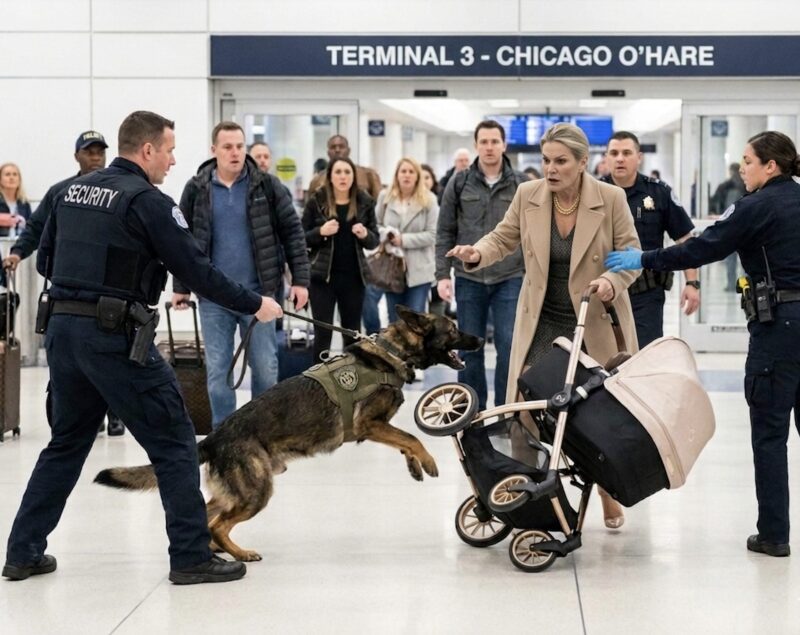
The injured service dog resisted the doctors until the very end, refusing to let them remove his collar. But when they finally managed to cut it off, they saw something truly horrific underneath.
I’ve been working in the emergency room for sixteen years, and during that time I’ve learned not to let the pain of others get to you, otherwise you simply can’t survive in this job. You see too much in one shift—broken lives, fear, the last words of people for whom nothing can be changed. Over time, you stop reacting like a normal person and just do your job. I was sure that nothing could shake you.
But that night, everything was different.
At the end of November, there was a fierce storm, pouring rain, and wind. The lights in the hospital were constantly flickering, and thanks to coffee and the habit of working non-stop, we kept working. Around two in the morning, a call came on the radio. The paramedic spoke strangely; his voice was tense.
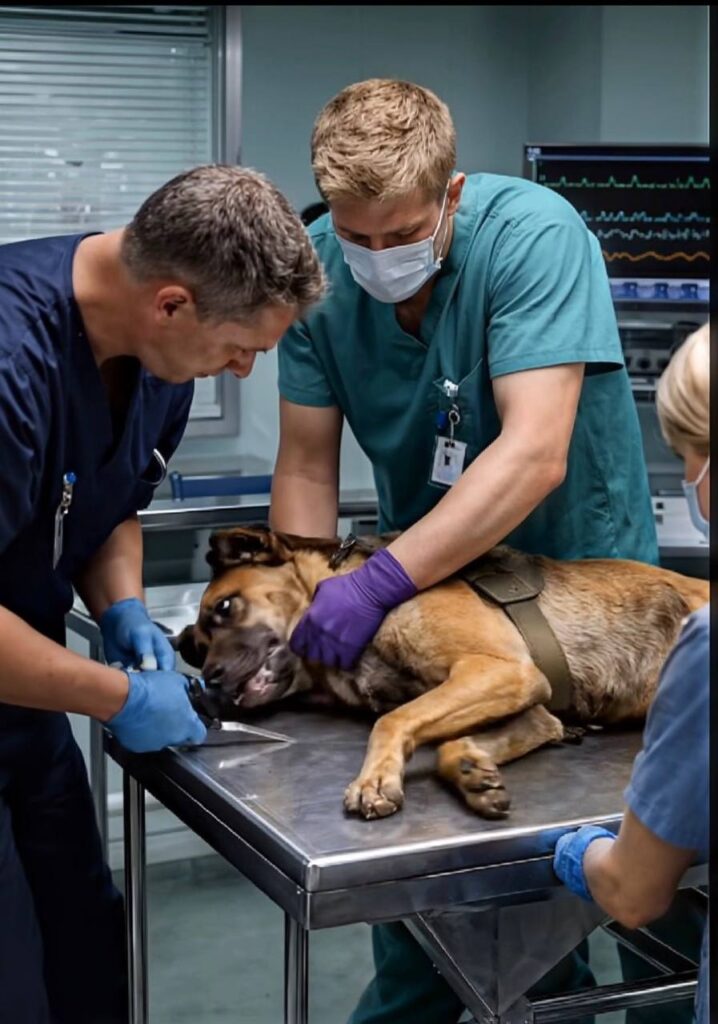
They had to deal with a serious road accident; a car had gone off the road and fallen into a ravine, half submerged in the river. But there was no patient in the car that they could take away. The person was still there, under the water. But there was a dog – a service dog, a police dog.
The animal had somehow made it to the road and was in critical condition. The vet’s office was too far away, the roads were flooded, and the dog was brought to us.
The rules say we’re not allowed to treat animals, but sometimes the rules mean nothing. I told them to bring him in.
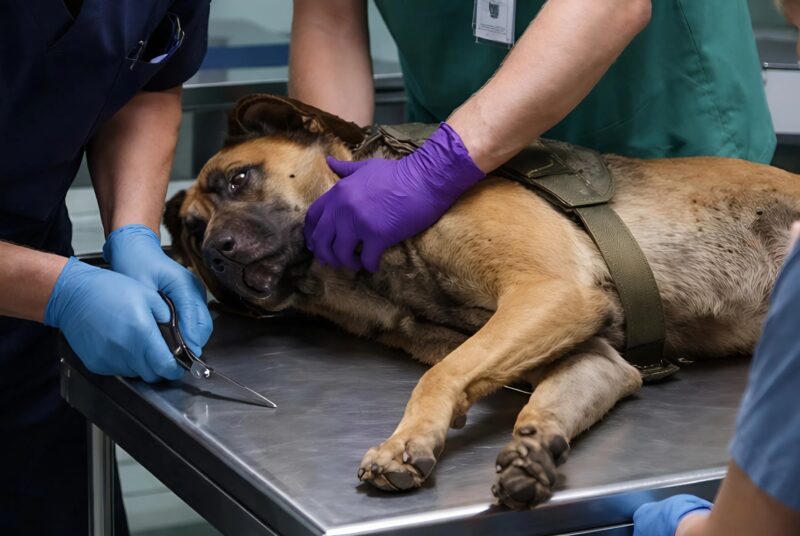
When the doors opened with the stretcher, cold air and the smell of damp earth filled the ward. On the stretcher lay a large German shepherd. Its fur was covered in red spots and mud, its breathing was labored, and its body was shaking from pain and cold. But even in this state, he remained focused, as if clinging with the last ounce of his strength.
He was wearing a heavy tactical harness with a sheriff’s badge strap. The collar was torn, and there was clearly a serious injury underneath, but until we took it off, we wouldn’t understand what was happening.
I reached for the straps and began to speak to him calmly, trying not to scare him. But as soon as my fingers touched the harness, the dog suddenly raised his head, growled, and tried to bite me. His jaw slammed right next to my hand, tearing through the glove. It wasn’t just fear. It was a deliberate warning.
We tried again, but again he lunged forward, barely able to stand. He wasn’t just resisting—he was protecting something.
I looked closer and realized that he was pressing his paws to his chest, as if to hide from us.
“He’s not afraid,” I said. “He won’t let us touch him.”
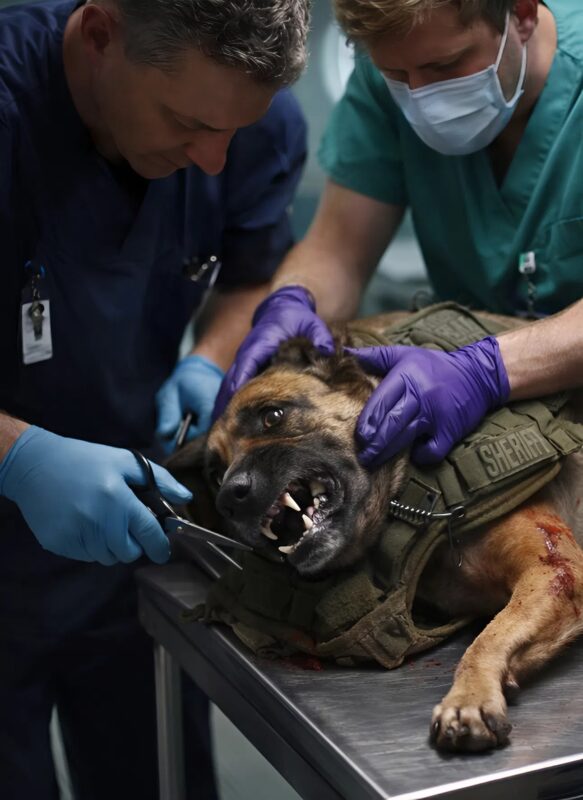
The paramedic confirmed that they couldn’t remove the harness on the spot either; the dog was behaving exactly the same. But we were running out of time; he was dying there on the table.
We restrained him, and I grabbed the scissors. He started to struggle even more than before, even though he was almost completely exhausted. There was a desperate resistance, as if he understood what was happening.
I cut the straps one by one, and at one point he made a strange sound—neither a growl nor a whimper, but something in between, as if he wanted to stop us one last time.
When the last strap snapped, the harness fell to the table. I was about to look for the source of the bleeding, but I froze. There was nothing under the collar that we had expected.
I stared at the dog, unable to comprehend what I was seeing. The dog was not afraid of us; he was not defending himself; he was simply something.
He was pressed against his bloody fur, hidden under the hardest layer of the protective vest for which the dog was willing to give his life.
I was panting; my legs felt like they wouldn’t obey me. I cautiously reached out with my trembling hands, unable to take my eyes off what lay before me.
Between the blood-soaked fur, pressed tightly against his body, was a small, waterproof capsule. I carefully removed it, and inside was a simple USB key.
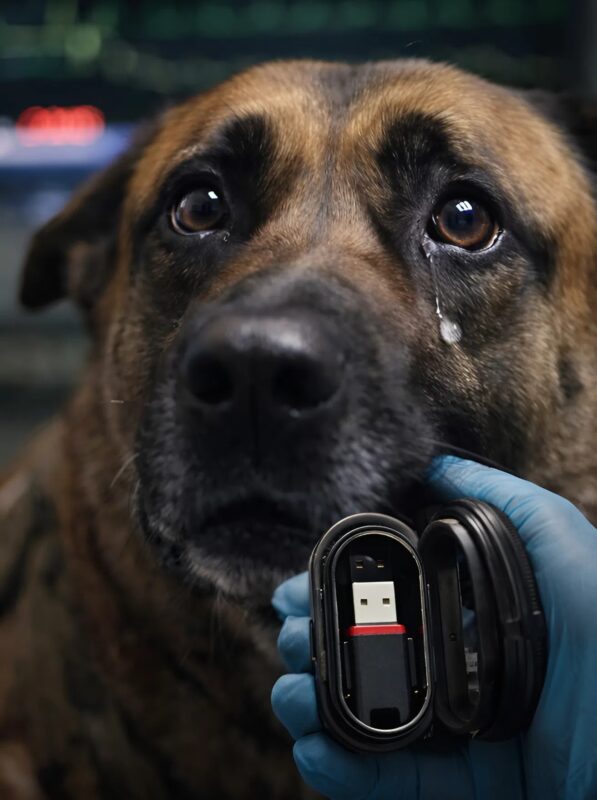
This is what he was protecting.
At that moment, I understood why he was resisting so desperately. Why he was trying to stop us even in his death throes. It wasn’t fear or aggression. It was an order. Later, everything became clear.
The police officer in the car had discovered some very influential people shortly before the accident. He had evidence that could destroy businesses, and perhaps even lives. The accident was not an accident. It was organized to get rid of him and the evidence.
But the police officer succeeded. Before he lost consciousness, he hid the USB drive in the dog’s harness and gave him one command – protect it at all costs.
And the dog obeyed. Even with his last breath. Even when we tried to help him. He didn’t defend himself.