It seems the semi-mythical wildcat has appeared in Belarus yet again. And this time, it didn’t go according to plan at all. Even considering there was no plan at all. Basically, the creature first entered a village chicken coop, killed several birds, then fell into a trap left there, and mysteriously disappeared the next day (leaving behind a video). Now everyone is wondering how this is possible. And we’ve learned how this all works from a legal and regulatory perspective.
Who is this anyway?
Let’s review the background. The wildcat saga has been going on for years. It was believed that the last Belarusian specimen was killed by a hunter in 1927. Until 2017, when a similar creature was captured by a camera trap in the Belarusian part of the Chernobyl zone (not very clearly).
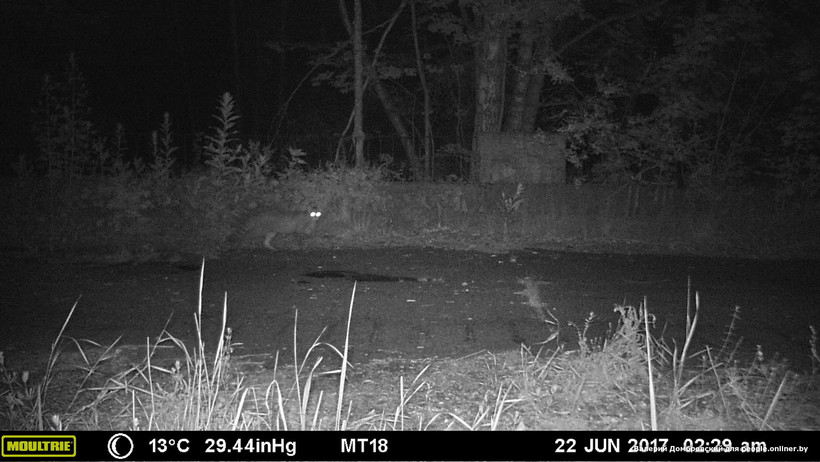
Everyone knew in their hearts it was him, but the photo wasn’t enough to formally confirm it.
And on June 16, 2025, a wildcat was captured on a badger camera trap in Pripyatsky National Park. He was showing off there with all his might.
Since then, he’s disappeared—despite attempts to locate him and obtain at least a little biomaterial for analysis.
He went looting
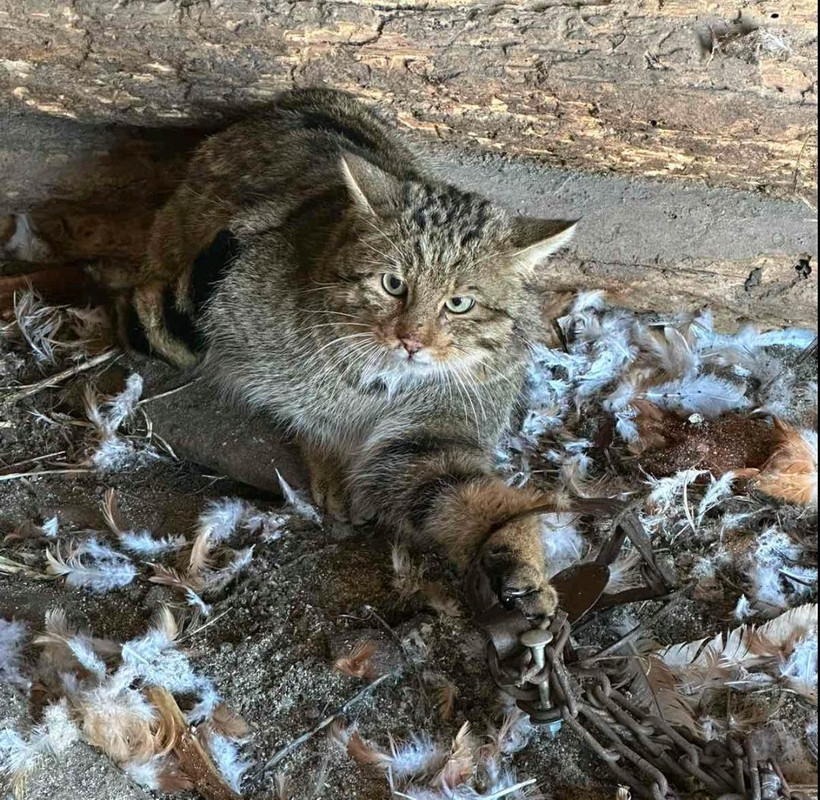
Amateur naturalist Yuri Malets, who learned of the latest supposed sighting of a wildcat from an eyewitness, informed us of the latest. The events unfolded in the village of Dzerzhinsk in the Lelchitsky District. On March 14, local residents discovered the animal in their barn: its paw had caught an abandoned trap. Before that, it had managed to kill six chickens.
Disappeared, along with the trap and chain.
The cat was temporarily left in the barn “until the circumstances were clarified.” The owners say they went to work, and when they returned, the pole was lying on the ground, and the cat was gone. They say he disappeared (along with the trap and chain) between 5:30 and 7:00 AM. Now everyone is wondering if he did it himself or someone helped.
A video remains, giving an idea of what the cat looked like.
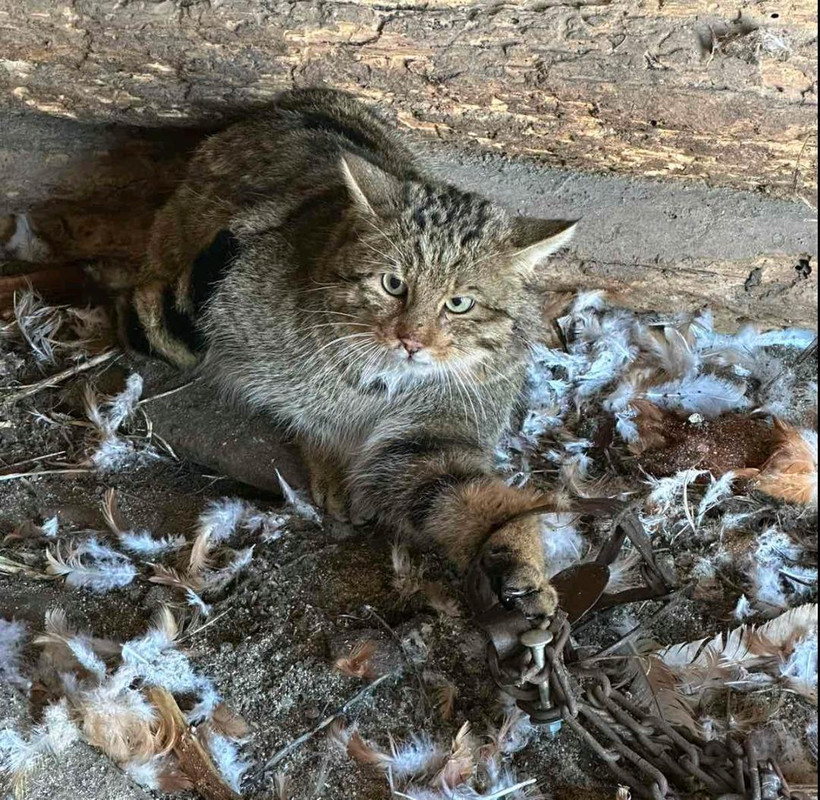
The Pripyatsky station confirmed to us that this isn’t “their” specimen; you can tell by its coloring. This means there may already be more than one wildcat in Belarus.
Perhaps biological traces of the missing animal (such as fur) remain at the site, which will finally allow us to physically confirm the animal’s species. We continue to follow this detective story.
Added: Was this even allowed?
Judging by the video, the animal’s paw is trapped in a pressure trap chained to a pole. The limb is likely irreparably injured, and the cat is in severe pain. This has horrified many social media users. Indeed, it’s important to understand how this situation appears from a legal and regulatory perspective.
The truth: from the perspective of some rural residents, small forest predators are not so much game as a threat to their livestock; they are trying to protect their livestock from them. Is it permissible to set traps and other pressure traps on your property—at home, in outbuildings, at your dacha, or in your garden? After all, anyone can technically own or buy a trap (unlike a firearm). Traps of varying types, strengths, and cruelty levels are readily available online.
Trapping is still permitted by hunting regulations, despite protests from animal rights activists. Meanwhile, several years ago, Belarus began to ban pinch traps as inhumane. This trap is no longer listed as permitted. But in any case, this only applies to hunting grounds, which are not home-based. What’s the deal?
We contacted the Association of Animal Protection Organizations for comment. They insist: traps are only permitted on hunting grounds; their use on private property or public land is prohibited by law. The Association is monitoring the situation in the Lelchitsy District, where a wild animal (presumably a wildcat) was caught in a trap in a private home and disappeared without a trace. We have already submitted an official statement to the State Inspectorate for the Protection of Fauna and Flora, requesting an investigation.
If the illegal setting of the trap is confirmed, the actions of the unidentified person constitute an offense punishable under Article 16.27 of the Code of Administrative Offenses of the Republic of Belarus (violation of hunting regulations). There is an aggravating circumstance. The disappearance of the animal along with the trap indicates a possible concealment of evidence, which should be taken into account during the investigation.
Furthermore, the value of the species must be considered. The wildcat is a rare species, and its illegal harvesting is detrimental to biodiversity.
The Association is currently insisting on interviewing witnesses, identifying the owner of the trap, and searching for the animal (or its remains) as evidence.